


There is a reason
your eyes age,
we finally understand it

Your eyes lose specific lipids with age.
Standard supplements can’t replace them.
Vision Lipids™ can.

Why standard
supplements fall short

01

Not about intake

Your body may still receive the nutrients it needs, even as your eyes age.

02

The pathway slows

Your body’s ability to turn those nutrients into the lipids your eyes use slows down with age.

03

Output falls short

So even when you’re getting plenty of fatty nutrients, less of what you take in becomes what your eyes actually need.
What if your eyes didn’t have to wait on a slower pathway
What if they could get those lipids straight from the source?

Introducing
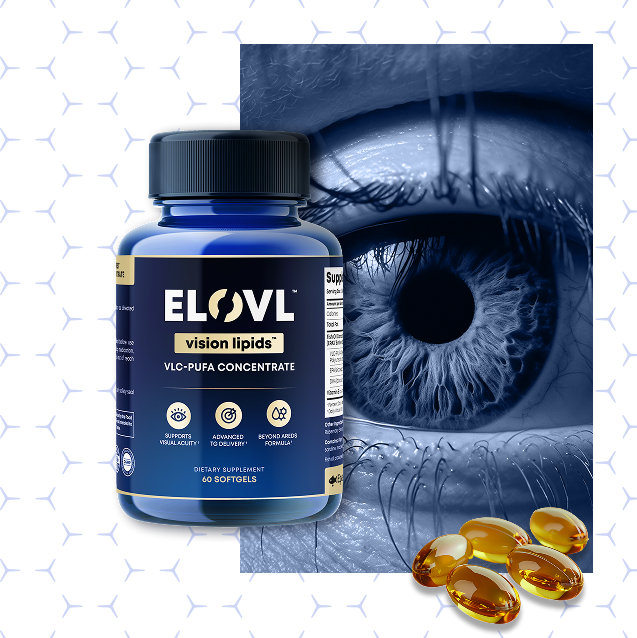
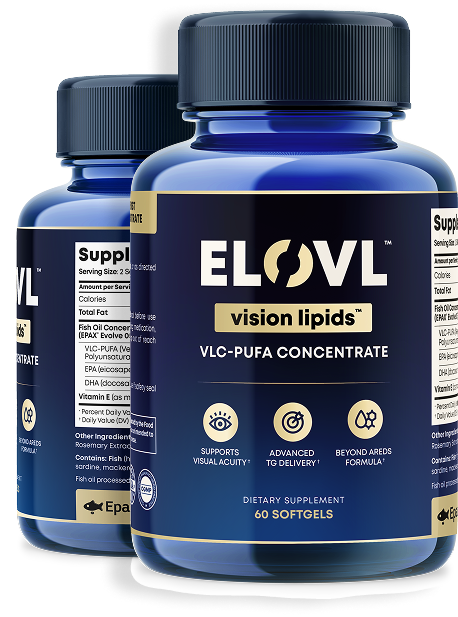
ELOVL™ Vision Lipids

The specialized lipids your eyes actually use

Starts where your body’s natural pathway slows down, so your eyes get what they need most.
Supplements what your eyes lose with age

The world’s first VLC-PUFA supplement for aging eyes

The result of decades of research

Decades of research showed which lipids your eyes need

Recent studies confirmed they matter for aging vision

Today, you can finally get them in a softgel

In partnership with Epax®

Vision Lipids features EPAX® Evolve 05, the world’s first commercially available VLC-PUFA concentrate — developed through a decade of R&D and patented processing.

Founding Member Offer

Reserve your spot.
Get 10% off at launch.

Founding members who join today get 10% off Vision Lipids at launch.

Your launch discount will apply automatically to your first order, and it stacks with any subscription you choose.

No cost to join. Your 10% discount will be applied automatically when we launch. No code needed.

Offer valid for first-time orders. Stackable with any subscription.

Supporting aging vision by delivering what the retina can no longer make on its own.
Measuring ELOVL2 activity as a window into how fast you’re aging at the cellular level.
Tools to monitor and measure visual function over time.
The Science, Simply Explained

What’s happening inside your eyes

01 Constant demand
Your retina never rests — and that makes it vulnerable.

Your retina never rests. It processes light continuously — and that constant work consumes more oxygen per gram than almost any other tissue in your body. That metabolic intensity makes it uniquely vulnerable to damage over time.

VLC-PUFAs — very long-chain polyunsaturated fatty acids — are the structural fats that protect photoreceptor membranes under that constant load. A lipid is simply the scientific word for a fat; VLC-PUFAs are a specialized type: longer, rarer, and built specifically for sensitive tissues — in particular, the retina. Less fuel, more armor. The material keeping the engine from burning itself out.

Your body doesn’t get VLC-PUFAs from food directly. It builds them internally, using an enzyme called ELOVL2 as the starting point. Think of ELOVL2 as the foreman of a small production line inside your cells. When it’s running, your retina gets what it needs. Starting in middle age, though, the gene controlling ELOVL2 gets progressively switched off — not broken, just silenced — through a natural process called DNA methylation. Researchers have found this silencing tracks so closely with how old your body is at the cellular level that ELOVL2 has become one of the most reliable biological aging clocks ever identified.

Standard omega-3 supplements give your body the raw ingredients it would normally convert into VLC-PUFAs. But that conversion requires ELOVL2 working.

When the enzyme goes quiet — as it does after 40 — those omega-3s have nowhere to go. It’s like delivering ingredients to a kitchen where the stove has been turned off.

This explains one of the most puzzling findings in eye health research: the landmark AREDS2 trial, one of the largest macular degeneration studies ever done, found no benefit from fish oil supplementation. The raw material was there. The enzyme to use it wasn’t.

THE BIGGER PICTURE

ELOVL2 is part of a broader aging process

These lipid pathways are being studied across multiple tissues involved in aging.
The retina is where the science is most developed — which is why ELOVL Vision Lipids is focused there.

Brain & Cognition

VLC-PUFAs are present in neural tissue and are being studied for their role in signaling and brain function.

Skin & Barrier Function

Related lipids support skin structure and barrier integrity, with changes observed over time.

Cellular Aging

ELOVL2 activity is closely associated with biological aging at the cellular level.

Cardiovascular Health

Early research explores links between lipid pathways and metabolic and inflammatory processes.

Reproductive Health

These lipids are found in high concentrations in reproductive tissues and remain an active area of study.

Longevity Science

These pathways are being studied for their role in age-related cellular processes across the body.

Note: Research across these systems is still emerging. Vision Lipids is formulated specifically for eye health.

coming soon

Launching 2026.
Reserve your spot.

Medical Disclaimer

The information on this page is for general educational purposes only and does not constitute medical advice. Vision Lipids is a dietary supplement, not a drug, and has not been evaluated or approved by the Food and Drug Administration to diagnose, treat, cure, or prevent any disease — including age-related macular degeneration or any other eye condition. Research referenced here was conducted primarily in laboratory and animal models; results in humans may differ. Descriptions of research on tissues other than the retina are provided for educational context only and do not constitute product claims. If you are experiencing vision changes or have concerns about your health, consult a licensed healthcare professional. Do not delay or discontinue medical care based on anything on this page. Individual results from dietary supplementation vary.